

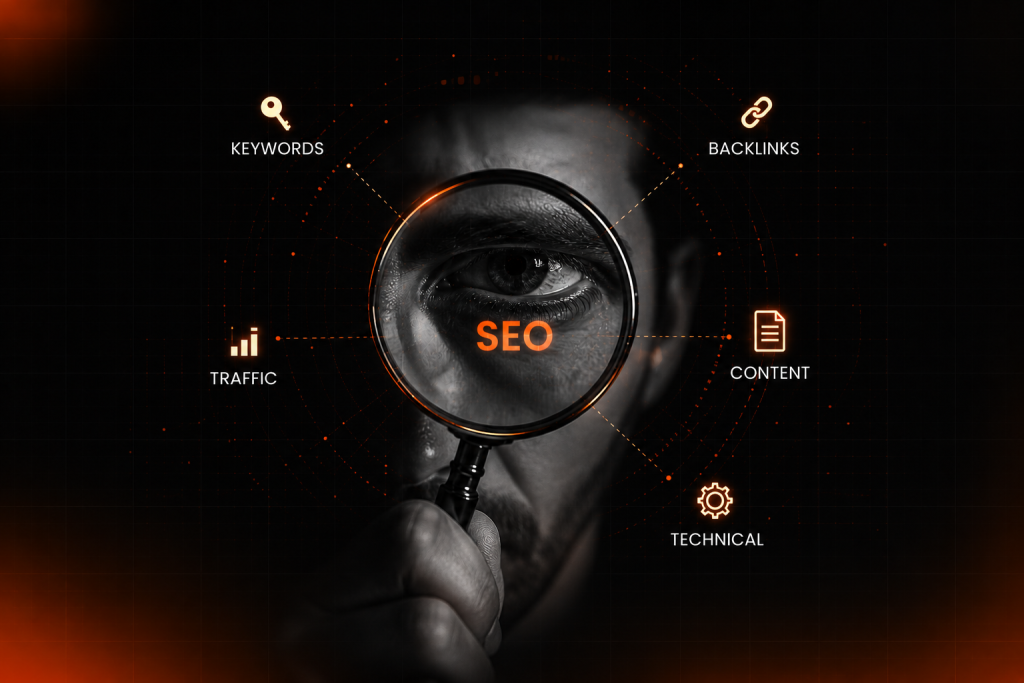
“The More You Look, The Less You See.”
At first, the phrase sounds strange.
How can looking more make you see less?
But the more you think about it, the more powerful it becomes.
Sometimes, when we become too focused on finding something, analysing every detail and chasing every possible answer, we lose sight of what is right in front of us.
And surprisingly, this is exactly what happens to many businesses with their marketing and SEO.
They look at more data.
They chase more keywords.
They want more traffic.
They publish more content.
They run more campaigns.
Yet somehow, they still fail to see the one thing that actually matters:
Are we solving the right problem for the right audience?
The Business World Is Looking at More Than Ever
Modern businesses have access to more information than any generation before them.
Website analytics can tell us where visitors come from. Social media platforms show us impressions, reach and engagement. SEO tools provide thousands of keywords, ranking positions and competitor insights.
The problem is not the lack of information.
The problem is knowing what information actually matters.
A business can celebrate getting 100,000 website visitors while generating very few customers.
A brand can have thousands of followers but struggle to sell.
A website can rank for hundreds of keywords while failing to attract people who are actually interested in its products or services.
That is where the phrase becomes important:
The more you look, the less you see.
When businesses become obsessed with numbers, they can easily miss the meaning behind those numbers.
More Traffic Does Not Always Mean More Business
This is one of the biggest misconceptions in digital marketing.
Businesses often assume that the solution to poor sales is simple:
“We need more traffic.”
But what if the real problem is not traffic?
What if people are visiting your website but don’t understand what you offer?
What if they find your content but it does not answer their questions?
What if your website attracts people who were never likely to become customers?
More traffic cannot automatically fix a weak customer journey.
In fact, chasing traffic without understanding intent can simply give you more people leaving your website.
Sometimes, the business does not need more visitors.
It needs to better understand the visitors it already has.
SEO Is Not Just About Keywords
This is where many businesses also misunderstand SEO.
SEO is often reduced to a competition for keywords:
- Find more keywords.
- Rank for more keywords.
- Get more traffic.
But keywords are only part of the story.
Behind every search is a person.
A person with a question.
A problem.
A need.
Or an intention to make a decision.
The real question is not simply:
“How many keywords are we ranking for?”
The better question is:
“Are we appearing when the right people are searching for what we can genuinely help them with?”
That difference can completely change an SEO strategy.
The Danger of Looking at the Wrong Metrics
Metrics are important.
Data is important.
Analytics is important.
But data without context can be misleading.
A number can look impressive while hiding a serious problem.
For example:
- High traffic with low conversions.
- High impressions with very few clicks.
- Thousands of followers with little real engagement.
- Strong keyword rankings for searches that do not support business goals.
This is why marketers and business owners must learn to look beyond surface-level success.
Don’t just ask whether the numbers are growing.
Ask whether the business is moving in the right direction.
Sometimes You Need to Step Back to See Clearly
One of the most valuable things a business can do is stop chasing everything at once.
Step back.
Look at the bigger picture.
Ask simple questions:
- Who are we trying to reach?
- What are they actually searching for?
- What problem are we helping them solve?
- Why should they choose us?
- What happens after they find us?
These questions may sound simple.
But they are often more valuable than another long list of keywords.
Because sometimes clarity does not come from collecting more information.
It comes from understanding the information you already have.
What Businesses Should Focus on Instead
Rather than simply chasing more, businesses should focus on becoming more intentional.
1. Understand Search Intent
Don’t just target what people are searching for. Understand why they are searching for it.
A person looking for information has different needs from someone ready to buy.
2. Focus on Relevant Visibility
Being visible everywhere is not necessarily the goal.
Being visible in the right places, to the right people, at the right time is far more valuable.
3. Connect SEO to Business Goals
SEO should not exist simply to generate rankings.
It should support awareness, trust, leads, customers and long-term business growth.
4. Look Beyond Vanity Metrics
Traffic, followers and impressions can be useful indicators.
But they should never become the entire definition of success.
5. Build for People, Not Just Platforms
Search engines change.
Algorithms change.
Platforms change.
But the need to understand and help people remains constant.
The Real Meaning Behind “The More You Look, The Less You See”
For me, this phrase is a reminder that more effort does not always produce more clarity.
You can look harder and still miss the obvious.
You can collect more data and still misunderstand your audience.
You can target more keywords and still fail to build meaningful visibility.
You can get more traffic and still generate less business.
Sometimes, the answer is not to do more.
Sometimes, the answer is to look differently.
The More You Look, The Less You See.
And perhaps that is one of the most important lessons for modern businesses, marketers and SEO professionals.
Don’t get lost in the numbers.
Don’t chase visibility without purpose.
Don’t confuse activity with progress.
Look deeper. Look differently. And make sure you are actually seeing what matters.
Evans Kongnyuy
Marketing | SEO | Digital Strategy | AI