
How Businesses in Cameroon Can Prepare for AI-Powered Search in 2026
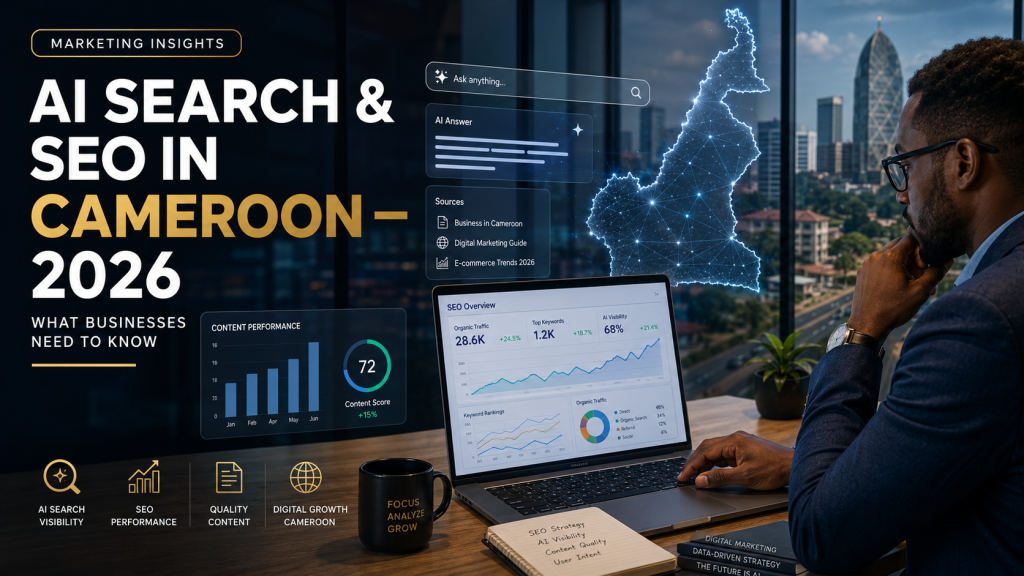
AI-powered search is changing the way people discover information, products and businesses. For companies in Cameroon, the question is no longer whether search will change, but whether their digital presence is ready for that change.
The search experience is evolving rapidly.
People are increasingly asking longer, more conversational and more complicated questions. Instead of searching only for individual keywords, users can now ask search engines questions that require information from several sources.
Google’s AI Overviews and AI Mode are part of this broader transformation.
But there is an important misconception that businesses need to understand.
Preparing for AI search does not mean abandoning SEO and replacing it with a completely new system.
Google’s current guidance says that existing SEO best practices remain relevant because its generative AI search features are built on Google’s core Search ranking and quality systems. Websites still need to be crawlable, indexable, useful and technically accessible.
For businesses in Cameroon, this creates a practical opportunity: improve the quality of the digital information you already provide instead of chasing every new AI optimisation trend.
What Is AI-Powered Search?
Traditional search primarily presents a list of webpages that may answer a user’s question.
AI-powered search can go further by helping users understand complicated questions, synthesising information and providing links to websites that support the answer.
Google explains that AI Overviews and AI Mode can use related searches and information from multiple sources to construct responses and surface supporting webpages.
This creates a new opportunity for businesses.
A website does not necessarily have to be the first traditional result for every possible query to be useful in an AI-powered search experience.
It needs to provide information that is relevant, accessible and valuable enough to potentially become part of the information ecosystem supporting a searcher’s answer.
Why This Matters for Businesses in Cameroon
Cameroon is developing a more sophisticated digital economy.
Businesses across sectors are investing in websites, social media, online advertising, e-commerce, content marketing and search visibility.
At the same time, customers are becoming more comfortable using digital channels to research companies before making decisions.
A potential customer may search:
- Which digital marketing agency is best in Cameroon?
- Where can I find an SEO consultant in Yaoundé?
- What is the cost of digital marketing in Cameroon?
- How can a small business get more customers online?
- Which university offers a particular programme?
- Where can I find a particular professional service in Bamenda?
These are not simply information searches.
Many contain commercial or decision-making intent.
That means businesses need to think seriously about what information exists about them online.
Step 1: Make Sure Google Can Find Your Website
The first step toward AI search visibility is surprisingly basic.
Google needs to be able to access and index your website.
Google’s documentation states that pages need to meet the normal technical requirements for Search and be eligible to appear with a snippet in order to be eligible as supporting links in AI features. There are no separate technical requirements specifically for AI Overviews or AI Mode.
Businesses should therefore check:
- Whether important pages are indexed.
- Whether Googlebot can crawl the website.
- Whether important pages are blocked by robots.txt.
- Whether pages accidentally contain noindex directives.
- Whether the website works properly on mobile devices.
- Whether the site is served securely through HTTPS.
- Whether important information is available as text.
Google Search Console should be one of the basic tools in every serious website owner’s SEO toolkit.
Google specifically recommends Search Console for diagnosing technical issues and monitoring search performance.
Step 2: Build a Website Around Topics, Not Random Articles
One of the problems with many business websites is that their blog becomes a collection of unrelated articles.
One week the company publishes an article about SEO.
The next week it publishes something about social media.
Then it publishes a generic article about entrepreneurship.
Eventually, there is a large amount of content but very little structure.
A stronger approach is to build topic clusters.
For example, a digital marketing consultancy could create a central resource about digital marketing in Cameroon and connect it to supporting articles about:
- SEO in Cameroon
- Local SEO in Cameroon
- Digital marketing strategies
- Digital marketing costs
- Online customer acquisition
- Choosing a digital marketing consultant
- Digital marketing for small businesses
This creates a connected information architecture.
It also gives search engines clearer signals about the subjects the website covers.
Businesses can explore the broader Digital Marketing in Cameroon resource as an example of how a topic can be developed into multiple related areas.
Step 3: Strengthen Internal Linking
Internal links are often overlooked by small businesses.
Yet they are one of the simplest ways to connect related information on a website.
Google’s current AI search guidance specifically recommends making content easily discoverable through internal links.
Instead of allowing every article to exist independently, businesses should connect related pages naturally.
For example, an article about digital advertising could link to a broader digital marketing strategy guide.
An article about SEO could link to local SEO.
An article about local SEO could link to Google Business Profile optimisation.
This creates a logical path for both users and search engines.
For a Cameroonian business, this can also help establish topical authority around specific local services and markets.
Step 4: Publish Information That Is Difficult to Replace
This may become one of the most important principles of SEO in the AI era.
AI systems can generate generic explanations extremely quickly.
Therefore, businesses should ask themselves:
What information can we provide that is based on genuine experience, research or expertise?
That could be:
- Original market research
- Customer surveys
- Industry statistics
- Case studies
- Campaign results
- Professional experiences
- Interviews
- Local market observations
- Original comparisons
- Expert analysis
Google’s latest guidance specifically encourages unique, non-commodity content that provides value beyond information that could easily be reproduced elsewhere.
Step 5: Use AI Without Turning Your Website Into an AI Content Farm
There is nothing inherently wrong with using artificial intelligence to assist with content creation.
AI can help marketers research topics, organise ideas, analyse data, generate outlines and accelerate parts of the production process.
But there is an important distinction between AI-assisted content and mass-produced content created primarily to manipulate search rankings.
Google’s guidance warns that generating many pages with little additional value can violate its scaled content abuse policies.
The practical lesson is simple:
Use AI to increase the quality and efficiency of your work, not simply the number of pages you publish.
Before publishing an AI-assisted article, ask:
- Is the information accurate?
- Does it provide something useful?
- Does it contain original insight?
- Is the information relevant to the intended audience?
- Would a real reader be satisfied after reading it?
- Does it demonstrate genuine expertise?
Step 6: Add Local Context
Local relevance is a major opportunity for businesses in Cameroon.
A generic article about digital marketing can be produced for almost any country.
But an article explaining how a Cameroonian small business can use WhatsApp, Google Search, Facebook, local SEO and online advertising to acquire customers is much more specific.
Local context can include:
- Cameroonian consumer behaviour
- Local cities
- Local industries
- Local pricing realities
- Local search behaviour
- Local business challenges
- Local regulations where relevant
- Examples from Cameroonian businesses
This is why local SEO should be part of the broader digital strategy for businesses that depend on customers in specific locations.
Our guide to Local SEO in Cameroon explores this opportunity in greater detail.
Step 7: Build an Authoritative Digital Identity
A business website should not exist in isolation.
Customers increasingly encounter companies across multiple digital platforms.
A strong digital presence can include:
- Official website
- Google Business Profile
- Industry directories
- Professional publications
- Social media profiles
- Relevant third-party mentions
- Research publications
The goal is not to create hundreds of profiles simply for the sake of having links.
The goal is to create a consistent and credible digital identity.
This becomes particularly important when people search for a company’s name, founder, products or services.
Step 8: Don’t Waste Time on Fake AI SEO Hacks
The rise of AI search has created an enormous amount of marketing advice.
Some of it is useful.
Some of it is simply repackaged SEO terminology.
Google’s latest guidance directly addresses some of these misconceptions.
Google states that businesses do not need special AI-specific schema to appear in AI features. It also says that there is no need to create new machine-readable AI text files for this purpose.
Google’s latest guide also explicitly advises against tactics such as creating unnecessary llms.txt files, artificial content “chunking” strategies and pursuing inauthentic mentions as supposed shortcuts into AI search.
That does not mean technology is irrelevant.
It means businesses should prioritise proven fundamentals before chasing speculative tactics.
Step 9: Make Your Business Information Consistent
Businesses should review the information appearing across their digital ecosystem.
Important details include:
- Business name
- Website address
- Phone number
- Location
- Opening hours
- Services
- Business description
- Professional profiles
For businesses serving customers locally, accurate business information is particularly important.
Google’s AI search guidance also recommends keeping relevant Business Profile information up to date.
Step 10: Measure More Than Rankings
SEO success should not be measured only by whether a particular keyword moves from position 20 to position 10.
Businesses should also monitor:
- Organic traffic
- Search impressions
- Search queries
- Engagement
- Leads
- Sales
- Phone calls
- Form submissions
- Bookings
- Time spent on important pages
Google says traffic from AI search features is included in the overall Web performance reporting in Search Console. It also recommends looking beyond clicks and considering outcomes such as conversions, sign-ups, engagement and other valuable actions.
A Practical AI Search Checklist for Cameroonian Businesses
If a business wants to prepare for AI-powered search, the following checklist is a useful starting point:
| Area | What to check |
|---|---|
| Technical SEO | Can search engines crawl and index the important pages? |
| Content | Does the website answer real customer questions? |
| Originality | Does the content contain unique expertise or local insight? |
| Internal links | Are related pages logically connected? |
| Local SEO | Is the business visible for relevant local searches? |
| Business information | Is company information accurate and consistent? |
| AI usage | Is AI improving the content rather than simply increasing volume? |
| Measurement | Are traffic and business outcomes being tracked? |
The Bigger Opportunity for Cameroon
AI search should not be viewed only as a threat to existing SEO strategies.
It may also create opportunities for businesses that have historically struggled to compete for visibility.
Businesses with specialised local knowledge can create content that is highly relevant to specific audiences.
Professional firms can document their expertise.
Researchers can publish original findings.
Entrepreneurs can document their experiences.
Industry organisations can publish market reports.
And businesses can become information sources within their respective markets.
That is particularly valuable in a developing digital market where many questions about local industries, pricing, services and consumer behaviour still have relatively limited high-quality online resources.
What the Marketing Industry Is Becoming
The rise of AI search is also changing the role of the marketing professional.
The modern marketer increasingly needs to understand more than advertising.
They need to understand:
- Search
- Content
- Data
- Consumer behaviour
- Technology
- Brand strategy
- Analytics
- Artificial intelligence
This broader shift can already be seen in the evolution of Cameroon’s marketing ecosystem.
The Top Digital Marketing Agencies in Cameroon 2026 report documents agencies increasingly combining SEO, advertising, web development, social media, content and digital strategy.
Similarly, the Top Marketing Strategists & Professionals in Cameroon 2026 report highlights the growing range of expertise within the country’s marketing profession.
AI is now becoming another layer within that ecosystem.
Final Takeaway
Businesses in Cameroon do not need to panic about AI-powered search.
They need to become better at digital marketing.
That means building technically sound websites, understanding customers, publishing original information, developing local relevance, creating strong internal links and demonstrating genuine expertise.
Artificial intelligence can help businesses research, analyse and produce content more efficiently.
But the fundamental question remains the same:
Does your website provide something useful enough for people to trust, read, reference and return to?
If the answer is yes, the business is already moving in the right direction.
Google’s current guidance reinforces this principle: foundational SEO remains relevant for AI-powered search, and businesses should focus on useful, reliable, people-first content rather than chasing artificial shortcuts.
The future of search may be powered by AI, but the foundation of good digital marketing remains human value.
About Marketing Insights
Marketing Insights is part of the Cameroon Marketing Intelligence Program, an independent publishing and research initiative focused on marketing, digital transformation, artificial intelligence, SEO, business growth and consumer behaviour in Cameroon.
The publication combines practical marketing analysis with research into the country’s evolving digital economy.
Evans Kongnyuy brings practical experience from digital marketing, brand strategy, data analysis, research, training and agency work to the broader Marketing Intelligence Program. His perspective is informed by working with businesses, organisations, students and professionals across different areas of the digital ecosystem.
Related Reading
- AI SEO in Cameroon: What Businesses Need to Know in 2026
- Google’s AI SEO Guide: What Businesses in Cameroon Should Know
- Top Digital Marketing Agencies in Cameroon 2026
- Top Marketing Strategists & Professionals in Cameroon 2026
- SEO in Cameroon
- Local SEO in Cameroon
- Digital Marketing in Cameroon
- Digital Marketing Strategies in Cameroon